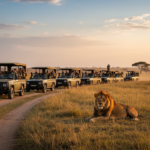
The night vs dawn game drive question is one of the most practical planning decisions a Masai Mara visitor faces, and the answer depends on a fact that many itineraries leave unstated: your camp location determines which drives are actually available to you.
This article covers where each drive type is permitted, what wildlife each window delivers, and how to structure your schedule depending on where you are staying.
Night Game Drives in the Masai Mara: Where They Are and Are Not Allowed
The access rules differ sharply between zones, and understanding them upfront saves confusion when building your itinerary.
Inside the Masai Mara National Reserve, night game drives are not permitted. All vehicles must exit through reserve gates by approximately 7:00 pm. This is a firm rule enforced by reserve rangers with no exceptions for private bookings.
Inside the private conservancies that border the reserve, night drives are fully permitted. The main conservancies offering this include Olare Motorogi, Naboisho, Mara North, Ol Kinyei, and Mara Siana. Camps within these areas conduct night drives using red-filtered spotlights, which illuminate animals at close range without triggering a stress response.
The practical consequence is direct: if your camp sits inside the national reserve, night drives are not available to you regardless of what you request. If your camp is in a conservancy, night drives are typically included in your daily schedule at no extra cost.
What a Night Drive Reveals
After dark, the Masai Mara presents a different ecosystem entirely. Species that spend daylight hours underground, in dense cover, or simply inactive emerge once the sun is gone.
Nocturnal wildlife commonly seen on conservancy night drives:
- Aardvark: one of the most sought-after night sightings, rarely glimpsed in daylight and visually unlike anything seen during the day
- Serval: a slender spotted cat with oversized ears and exceptional hearing, almost exclusively active after dark
- Genet: a civet-like predator frequently spotted moving through tree canopy or across camp structures at night
- Spring hare: a kangaroo-hopping rodent that appears in numbers across open grassland once the light fades
- Honey badger: famously fearless and regularly encountered on night drives in the conservancies
- Porcupine: slow-moving but striking when caught in the spotlight beam
- Bushbuck: a shy antelope that rarely shows itself in daylight
- Nightjars: several species hunt insects in flight after dark and are easily caught by the spotlight
Big cats after dark:
Lions and leopards are significantly more active at night than during the midday hours. A conservancy night drive can place you beside lions mid-hunt, with a leopard moving along a dry riverbed with its eyes catching the light, or with hyena clans gathered at a kill site. The organised stalk and coordinated hunt that lions execute at night is something daytime drives rarely capture, and watching it unfold in the spotlight is among the more extraordinary experiences the Mara ecosystem offers.
What a Dawn Drive Reveals
The Masai Mara 6:00 am game drive departs at first light and covers the transition period when nocturnal animals are finishing their night activity and daytime species are starting theirs.
Professional guides consistently rate the window between approximately 6:30 and 9:00 am as the single most productive drive period of the day. Predator sightings are at their peak, prey animals are most active, and the air carries a clarity and cool that disappears by mid-morning.
What dawn drives deliver:
- Lions at or near a recent kill before the heat of the day drives them into shade
- Leopards still active and often visible in acacia trees or moving along river drainages
- Cheetahs scanning open plains in early light, preparing to hunt
- Elephants moving in family groups toward water in the morning cool
- Buffalo herds crossing open grassland in large, unhurried groups
- Golden hour light: warm, directional, and photogenic in a way that no other time of day matches
One thing a night drive cannot offer:
Cheetah hunting is a daytime behaviour. Cheetahs rely entirely on sight to hunt and do not operate after dark. Dawn is the strongest window in the Mara to observe a cheetah hunting or to catch the moments of scanning and positioning that precede a chase. If cheetah behaviour is a priority, the dawn drive is where that opportunity lives.
Bird activity also peaks at dawn, with territorial calls, raptor movement, and aerial displays that simply do not occur at night.
Night vs Dawn Game Drive: A Direct Comparison
| Factor | Night Game Drive | Dawn Game Drive |
|---|---|---|
| Availability | Conservancy camps only | All camps |
| Typical departure | 7:30 to 8:00 pm | 6:00 to 6:30 am |
| Duration | 2 to 3 hours | 3 to 4 hours |
| Nocturnal species | Yes (aardvark, serval, genet, honey badger) | No |
| Big cat activity | Most active, often hunting | Still active at daybreak |
| Cheetah | Not applicable (daytime hunter) | Prime window |
| Photography | Red spotlight; atmospheric but technically demanding | Golden hour; best conditions of the day |
| Other vehicles | Typically none | Low to moderate depending on season |
| Temperature | Cool to cold | Cool, warming through the drive |
Explorer Notes
Spotlight photography requires preparation. Red-filtered spotlights produce low, reddish light that demands higher ISO settings and wider apertures. Night drive images tend to be atmospheric rather than technically precise. If sharp wildlife photography is your main goal, the dawn drive is more forgiving. That said, the atmosphere of a spotlight encounter with an aardvark or a hunting leopard is something that post-processing cannot replicate from a daylight shot.
Cold temperatures are a real factor. Night drives in the conservancies can be genuinely cold, particularly between July and October. Bring a fleece or light down layer even if daytime temperatures felt mild. Blankets are sometimes available in vehicles, but packing your own is reliable.
The triple-drive day is the standard in conservancy camps. Many conservancy camps run three drives per day: dawn departing around 6:00 am, an afternoon drive departing around 4:00 pm with a sundowner stop, and a night drive departing around 8:00 pm and returning by 10:30 pm. This structure covers nearly the full 24-hour wildlife cycle and is one of the most wildlife-intensive day formats available in East Africa.
The choice is not always a choice. Travelers staying in the national reserve have one option: the dawn drive. Travelers staying in a conservancy have both. For the latter group, the question of which to prioritise rarely needs to be asked, because the two drives are complementary, not competing.
What to Take Away
Dawn and night drives do not cover the same ground. Dawn gives you the widest species range, the best photography conditions, and the highest density of big cat sightings. Night gives you a completely separate animal community, lion hunts in darkness, and the specialist nocturnal species that most visitors to the Mara never encounter.
For anyone with conservancy access, the practical answer is to run both. The drives cover different parts of the same 24-hour ecosystem, and separating them is how you get a complete picture of what the Masai Mara actually contains.
If this guide has you ready to travel, a safari specialist can handle the route, camps, and logistics end to end.
Want to Book a Tour With Us?